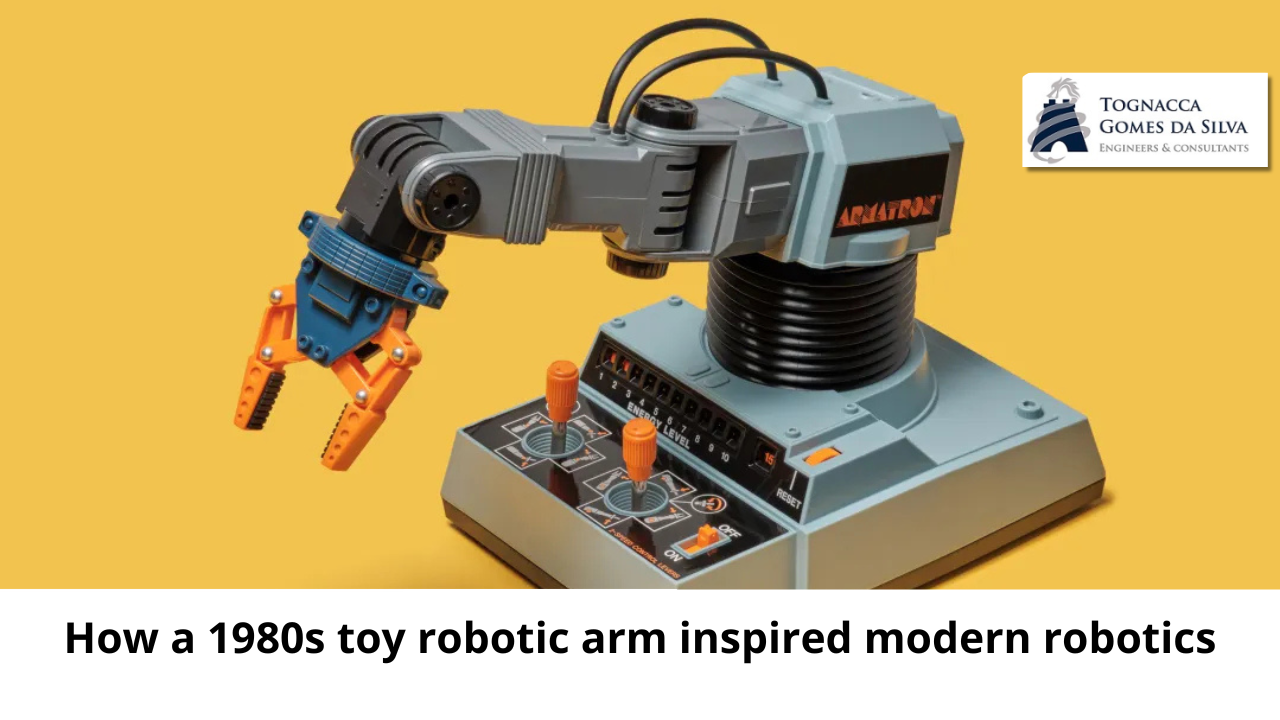



As the son of an electronics engineer, I spent a lot of time at my local Radio Shack as a kid. While my dad browsed for capacitors and resistors, I hung out in the toy section. It was there, in 1984, that I discovered the greatest toy of my childhood: the Armatron robotic arm. Described as a “robotic arm to assist young geniuses in scientific and laboratory experiments,” it was one of those rare toys that lived up to the hype printed on the front of the box. It was a real robotic arm.
You could rotate the arm around its base, tilt it up and down, bend it at the “elbow” joint, rotate its “wrist,” and open and close its bright orange articulated hand in elegant chords of motion, all using only the twin rotating joysticks.
A few years ago, I found my Armatron, and when I opened the box to get it working again, I was surprised to find that, aside from a compartment for a pair of D batteries, a switch, and a tiny 3-volt DC motor, the thing was completely devoid of any electronics. It was purely mechanical. Later, I found the Armatron’s patent drawings online and saw how incredibly complex the gearbox schematics were. This design was the work of a genius—or a madman.
It’s not hard to draw connections between the Armatron—an analogically impossible robot—and highly advanced machines that are now learning to move in incredible new ways, driven by advances in AI like computer vision and reinforcement learning.
( fontes: reddit )