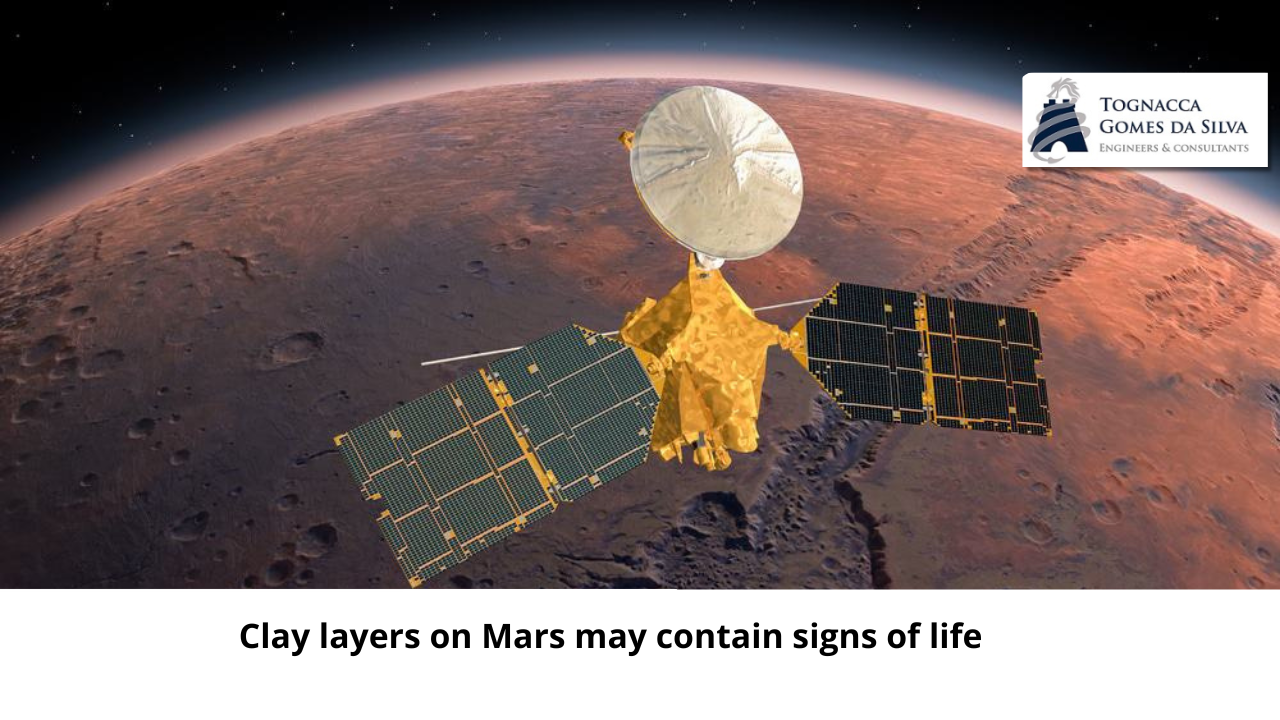



Scientists investigated the thick layers of clay on Mars, concluding that these environments could have been favorable to life in the planet’s past.
Conducted by a team from the University of Texas, USA, the research used data from NASA’s Mars Reconnaissance Orbiter (MRO) probe to analyze 150 clay deposits scattered over the Martian surface.
The results, published in the journal Nature Astronomy, indicate that most of these layers formed near ancient lakes, where the water remained stationary for long periods. These stagnant environments allowed chemical reactions that transformed soil minerals into clay, creating bulky and mineral-rich deposits.
Environmental stability helped preserve the Martian clay
Postdoctoral researcher Rhianna Moore, lead author of the study, explains in a statement that the stability of these regions, which have low altitude and little variation in relief, favored the preservation of these layers over time. This invariability may have been essential to maintain adequate environmental conditions for the development of life on Mars.
Billions of years ago, Mars had a wetter climate and an atmosphere capable of keeping liquid water on the surface. Rivers, lakes and aquatic environments were common, shaping the landscape and enabling geological processes that are now studied from clay layers.
Tim Goudge, assistant professor at the Department of Earth and Planetary Sciences and co-author of the study, compares the clayey environment of Mars to that of the tropical regions of our planet. “On Earth, the places where we tend to observe the thickest clay mineral sequences are those in humid environments and with minimal physical erosion, capable of removing newly formed weathering products,” he said. “These results suggest that the last element is also true on Mars, although there are also indications of the first.”
Clay layers altered the chemistry and carbon cycle on Mars
An important factor for the chemical composition of these regions is the absence of tectonic plates on Mars. Unlike the Earth, where the movement of the plates renews the soil and allows reactions between rocks, water and carbon dioxide that help regulate the climate, Mars does not have this mechanism.
This lack of renewal may have contributed to the prolonged stay of greenhouse gases in the Martian atmosphere, making the planet warmer and more humid in its ancient past. It can also explain the scarcity of carbonate rocks on Mars, which on Earth are formed by the reaction between carbon dioxide and volcanic minerals.

The continuous formation of clays would have “captured” minerals that, on Earth, would participate in the formation of these carbonates, altering the planet’s chemistry and its carbon cycle.
Funded by NASA and the Canadian Institute for Advanced Research, this study represents an important advance in understanding the environmental conditions that existed on Mars billions of years ago, offering clues about the possibility of life in the planet’s past.
( fontes: olhar digital)