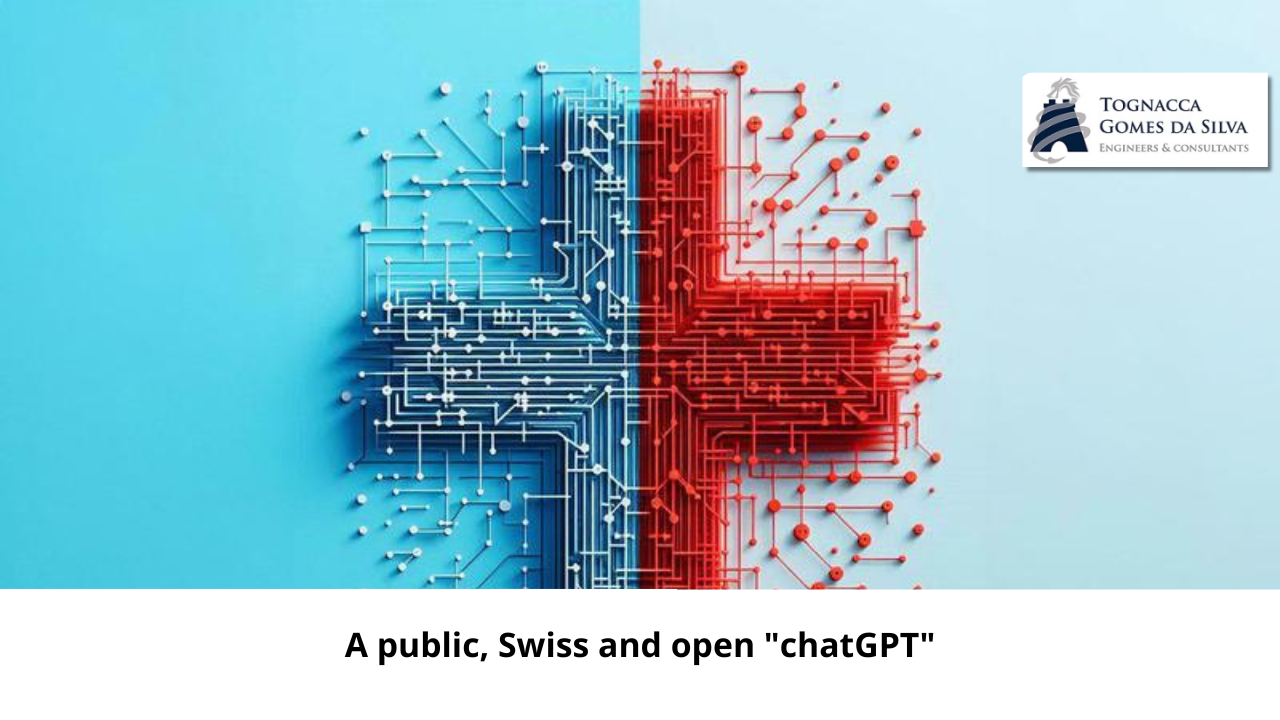



Large language model rhymes with ChatGPT for most of us. However, there are more than a million different models, according to the Hugging Face website. Recently, it was announced that, at the end of the summer, a new totally Swiss, public and free model, developed by the Federal Polytechnics of Zurich, ETH and Lausanne, EPFL, will be added to this long list. What seems to be a drop in the ocean is actually a milestone for the entire artificial intelligence sector, at least in Europe, because it represents a bulwark of transparency and ethical values.
The current systems that we all use, usually developed in the United States or China, are often accused of little openness to the public and experts. In fact, even those who have the technical skills to understand the code behind language models often cannot access the codes that compose them. Therefore, the closure prevents these tools from being fully reliable, because, for example, it is not possible to check if their answers were artificially directed in a specific direction, for example, on political issues, nor is it possible to know where the user data provided during use were stopped.
“Fully open source models allow the development of highly reliable applications and are fundamental to the advancement of research on artificial intelligence risks and opportunities. Transparent processes also facilitate compliance with regulations,” says Imanol Schlag, a researcher at the ETH AI Center who leads the project, along with EPFL AI Center professors Antoine Bosselut and Martin Jaggi. “Unlike business models developed behind closed doors, we hope that our fully open approach can stimulate innovation in Switzerland, throughout Europe and through international collaborations. In addition, it is a fundamental element to attract and value the best talents,” adds Martin Jaggi.
The large Swiss language model will be able to communicate fluently in more than 1,000 different languages, compared to about 7,000 languages worldwide. The system was trained in an extensive library consisting of 60% of documents in English and 40% in another 1,500, in addition to programming codes and mathematical formulas. Technical data already allows researchers to estimate that the system will be among the most powerful fully open models available.
The project, which is currently in the final phase of testing and does not yet have an official name, breathes the air of Italian Switzerland, because the long artificial intelligence training processes have been carried out in recent months in Lugano at the Swiss Center for Scientific Computing. Here, in the computer infrastructure called Alps, computers read large amounts of data, basically mainly texts and computer codes, to learn how to answer questions, translate from one language to another and talk to the user. The language model was also with attention to the climate, since the Swiss Center for Scientific Computing is powered by neutral carbon dioxide emissions.
“Training this model is only possible thanks to our strategic investment in Alps, a supercomputer designed specifically for artificial intelligence,” says Thomas Schulthess, director of the CSCS and professor at the University of Zurich, who continues – our long-standing collaboration with NVIDIA and HPE (two American computer component companies, ed) is a concrete example of how joint work between public research institutions and industry leaders can strengthen sovereign infrastructure by promoting open innovation, not only for Switzerland, but for science and society at a global level.”
The field test then remains to allow users to see if this model is really able to compare itself with the solutions of large companies. Certainly, however, its reliability and transparency will be fundamental ingredients to allow other scientists to build innovative solutions for projects of all kinds, as Antoine Bossolut concludes: “As researchers from public institutions, our goal is to promote open source models and allow organizations to develop their own applications in them”.
( fontes: RSI )