



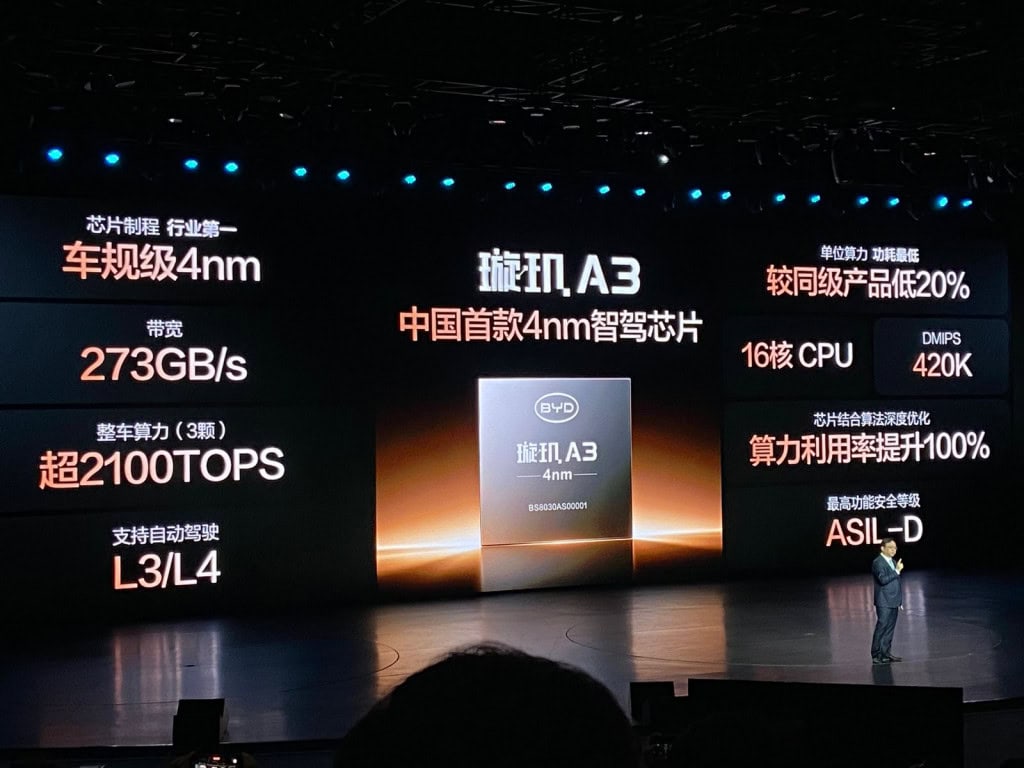
BYD Launches China’s First 4nm Intelligent Driving Chip and Enters the Semiconductor War
The Chinese giant BYD has just redefined the rules of the game in the automotive and technology sectors. In a historic announcement made on May 28, 2026, the automaker revealed its first intelligent driving chip featuring 4-nanometer (nm) lithography. This milestone not only consolidates China’s technological autonomy but also thrusts BYD directly into the epicenter of the global semiconductor war, directly challenging the hegemony of Western companies.
The 4-Nanometer Milestone and Autonomous Driving
Until now, the market for advanced chips for autonomous vehicles was largely dominated by North American companies such as Nvidia and Qualcomm. BYD’s new processor, designed entirely in-house, features a 4nm architecture that ensures exceptional energy efficiency coupled with massive processing power. The chip is capable of performing trillions of operations per second (TOPS), serving as the necessary backbone for the real-time processing of complex data originating from LiDAR sensors, radars, and multiple high-resolution cameras.
This superlative computational capacity is the fundamental requirement to support advanced autonomous driving systems, allowing the vehicle to make instant and safe decisions in chaotic urban scenarios and on high-speed highways, minimizing the need for human intervention.
Vertical Integration and Strategic Independence
The unveiling of this component highlights BYD’s aggressive and successful vertical integration strategy. The company, already a global benchmark for manufacturing its own batteries (such as the Blade battery) and electric motors, now masters the most complex and sensitive layer of the modern supply chain: silicon. Producing the “brain” of its own vehicles protects the automaker from international market fluctuations and potential technological export sanctions or restrictions, ensuring a continuous flow of production and uninterrupted innovation.
The Impact on the “Chip War”
By launching a 4nm semiconductor, China proves that it is effectively bypassing the extreme lithography machinery blockades imposed in recent years. BYD’s entry into cutting-edge processor design not only affects the dynamics of the automotive industry but sends a resounding warning signal to the entire global technological ecosystem. The move indicates that the Chinese industry has formed a highly resilient supply chain, capable of rivaling the cutting-edge technologies conceived in Silicon Valley on equal footing.
Launch and Availability
The official forecast released by the automaker is that the new 4nm chip will initially be integrated into the brand’s premium and luxury lines, such as vehicles from Yangwang and Denza, starting in the last quarter of 2026. In the following years, as manufacturing costs decrease, the technology will be scaled to BYD’s volume models, democratizing access to top-tier intelligent driving features for the end consumer.
