



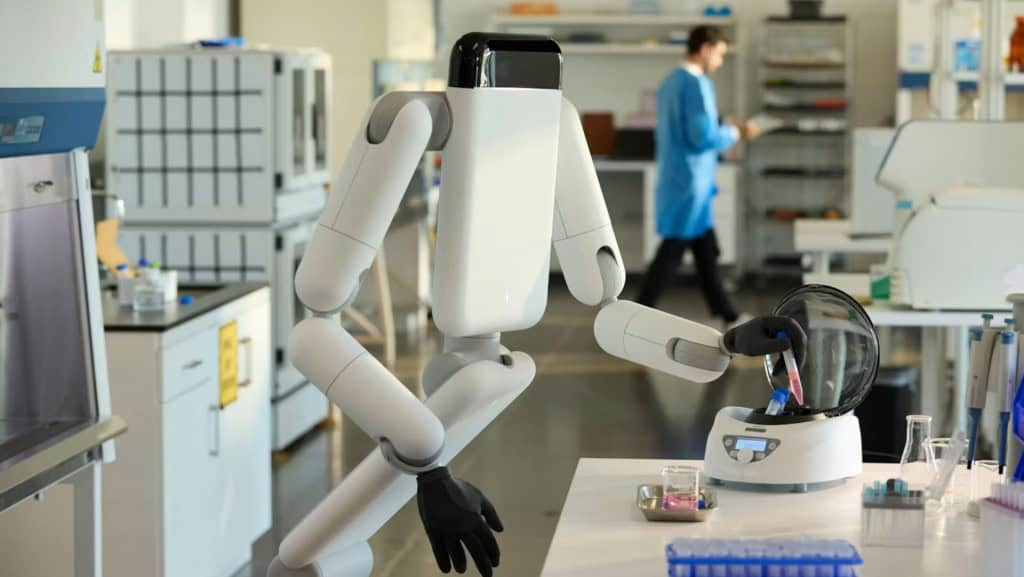
The Future of Humanoid Robots Might Be Less Human
Engineering’s obsession with creating robots that perfectly mimic human anatomy is undergoing a critical review in June 2026. Although the anthropomorphic format was the starting point for inserting machines into environments designed for people, robotics experts are beginning to signal that the true leap in efficiency will happen when we discard the biological limitations of the human body.
The Barrier of Human Biomechanics
The human body is a masterpiece of evolution, but it possesses severe physical restrictions. Our knees and elbows bend in only one direction, our necks have a limited field of rotation, and our balance depends on a complex center of gravity. By designing industrial humanoid robots bound by these same constraints, engineering ultimately limits the machine’s maximum potential.
360-Degree Joints and Non-Human Movements
The new prototypes presented by leading robotics companies in 2026 are beginning to adopt movements that would be impossible—and even uncanny—for a human being. We are talking about hip and shoulder joints capable of continuously rotating 360 degrees, allowing the robot to change direction without needing to turn its base or body.
These hybrid designs bring immense logistical advantages:
- Space Optimization: Robots that do not need to take steps backward or turn around can operate in much narrower industrial aisles.
- Reduced Mechanical Wear: Direct movements and continuous rotations eliminate the need for complex maneuvering, extending the lifespan of the actuators.
- Energy Efficiency: Fewer movements to execute the same task result in drastic savings in battery autonomy.
Perception Beyond Human Eyes
The structural shift also affects sensor and vision systems. Replacing the concept of a “face” with two frontal eyes with 360-degree integrated sensor arrays completely eliminates the machine’s blind spots. A robot operating on an assembly line in 2026 can manipulate an object in front of it while visually processing the approach of a human worker from behind, acting with much greater safety and precision.
Public Acceptance vs. Industrial Efficiency
Market analysts point out that the initial resistance to robots with less anthropomorphic appearances and movements is a psychological challenge, not a technical one. While the domestic assistance and healthcare markets may still demand machines that look friendly and familiar, the heavy manufacturing and logistics sector is prioritizing engineering pragmatism. The future of smart factories belongs to machines that move in a purely mathematical and optimized way.
Conclusion
Uncoupling the concept of “humanoid” from a faithful copy of our biology is the definitive step toward the maturity of robotics. By allowing robots to operate in a less human manner, we are finally enabling them to reach their full potential of utility and safety within the global industrial ecosystem.
