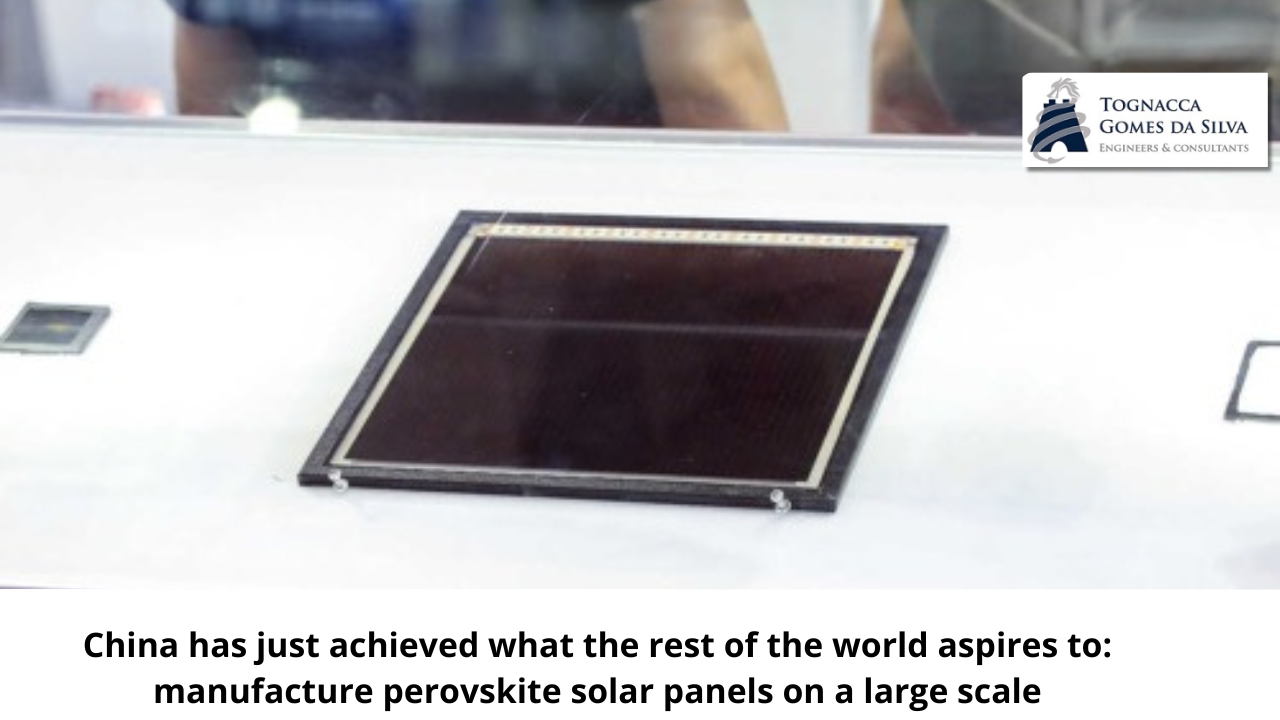



China not only leads the world in the production of solar panels: it has practically built its energy industry based on them. After years of focusing on the massive expansion of silicon panels, the country turned its attention to a more promising technology: perovskite solar cells.
The problem? Producing them on a large scale has been, so far, a huge technical challenge. However, solving this puzzle is, for China, a strategic issue, and everything indicates that it has just found the missing key piece.
The missing piece
After three years of work, a group of researchers from the Changchun Institute of Applied Chemistry – part of the Chinese Academy of Sciences – found a solution that can make a difference: an ultra-thin layer that improves the flow of electricity in perovskite solar cells. This is how they got the panels to perform better, last longer and, above all, could be mass-produced. And this is the missing piece for this technology to make the leap to the global market
In more technical terms, the discovery, published in the journal Science, created a “self-assembled double radical molecule”, which acts as a gap transport layer (HTL). This intermediate layer is essential for the proper functioning of solar devices, as it facilitates the movement of positive charges generated by light.
According to tests carried out by the team of researcher Zhou Min, the new material more than doubles the transport rate of cargo carriers under simulated conditions. And the most impressive thing is that the devices made with it have virtually unchanged performance even after thousands of hours of continuous use.
The heart of the matter
Perovskite solar cells have been making headlines for years. And it’s not for nothing: they are cheap, light, efficient and so versatile that they can be installed on facades, windows or fabrics. Everything indicated that they would be the natural successors of silicon. But there was a problem that remained unsolved: its fragility and the complexity of its large-scale manufacturing.
Thus, this new material addresses both challenges. On the one hand, it provides greater stability, which resists degradation over time. On the other hand, it can be manufactured easily and uniformly, even on large surfaces, without loss of quality. In addition, the innovation has received efficiency certification from the U.S. National Renewable Energy Laboratory (NREL), which gives it crucial technical support beyond China’s borders, according to Interesting Engineering.
Who seeks, finds
China does not want to repeat the saturation collapse it experienced with silicon. This time, it aims higher and further: not only to dominate production, but also to perfect the next generation of solar panels. With this advance, perovskite ceases to be a distant promise to become a tangible reality. If the technology can be commercially expanded – as research teams already plan – we may be witnessing the beginning of a new solar age: cleaner, more efficient and more accessible to all.
( fontes: xataka )