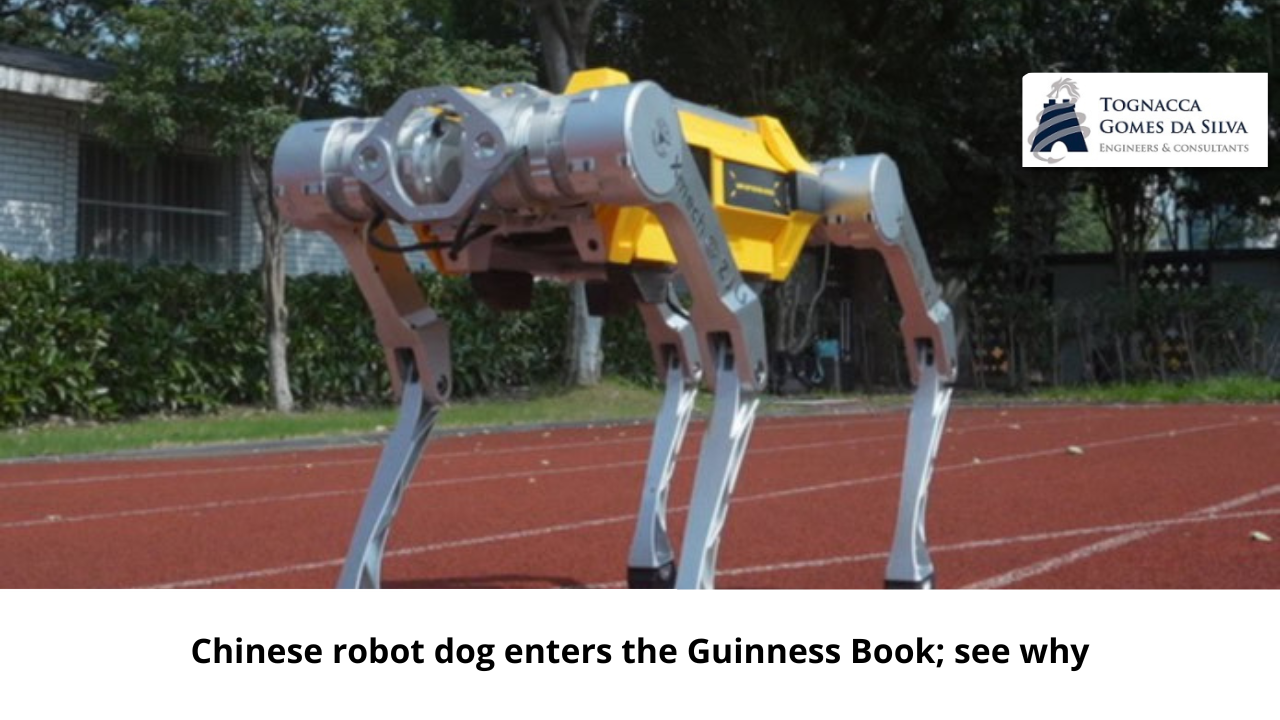



If among humans “the ray” did not find competitors, the story is a little different in relation to robots. The University of Zhejiang, in China, has just announced that one of its machines entered the Guinness World Records as the fastest on the planet.
It is true that White Rhino’s 100-meter mark in 16.33 seconds is lower than Bolt’s numbers. It is also true that another robot dog had already surpassed the athlete’s mark before. The difference now is that the Chinese robot did this in the real world, on a racetrack – and not in the laboratory (he didn’t even need moorings so as not to lose balance).
The White Rhino broke the previous mark, which belonged to the robot dog Hound, from South Korea, which made the route in 19.87 seconds. The new record was broken in May of this year; the official announcement, however, took place last Tuesday (12).
A sprinter with AI
Zhejiang University’s quadrupedal robot ‘White Rhino’ has set a new Guinness World Record! It sprinted 100m in just 16.33s, smashing the previous record of 19.87s held by Korea’s ‘Hound’. Developed under the ‘Qualitative-Intelligent Intersection’ philosophy, White Rhino overcomes… https://t.co/bGtDQxOl5Gpic.twitter.com/CtHpgkorOw— RoboHub🤖 (@XRoboHub) August 13, 2025
- Okay, I don’t speak Mandarin either, but the video above shows the impressive speed of White Rhino.
- Originally, the robot dog is an A2, also from the Chinese Unitree.
- But the scientists took the platform and worked on it – they made improvements.
- White Rhino was developed by a team that brought together the X-Mechanics Center at Zhejiang University, the China School of Aeronautics and Astronautics and the Hangzhou Global Center for Scientific and Technological Innovation.
- The project combined mechanical design, high-performance actuators and modern control algorithms.
- The project combined mechanical design, high-performance actuators and modern control algorithms.
- Scientists modeled how each part of the machine would behave in different real-world conditions.
- To do this, they used multi-objective optimization to adjust the geometry, engine specifications and reduction systems at the same time.
- The robot also works with the concept of reinforcement learning, which allows it to coordinate explosive impulses, rapid leg movements and real-time balance corrections.
- The result you saw above: he traveled 100 meters in just 16.33 seconds.
- Pode parecer pouco em relação ao Usain Bolt, mas faça você mesmo a corrida.
- Believe me, White Rhino will make numbers very similar to yours!

Other functions
In addition to the absurd speed, the White Rhino was also designed to withstand heavy loads. To be more precise, the model can carry up to 100 kilos on the back!
This combination of speed and load capacity differentiates the White Rhino from other research robots focused only on agility.
According to the researchers, the team’s goal is to make the project move from the “fast run” level to the “useful run” level.
The idea is that, one day, the White Rhino will be useful in emergency missions, such as search and rescue in disaster areas. With his high speed, he would be able to quickly access the places where the tragedy occurred. Its load capacity would allow it to take supplies and other tools to the rugged areas.
( fontes: Olhar Digital)