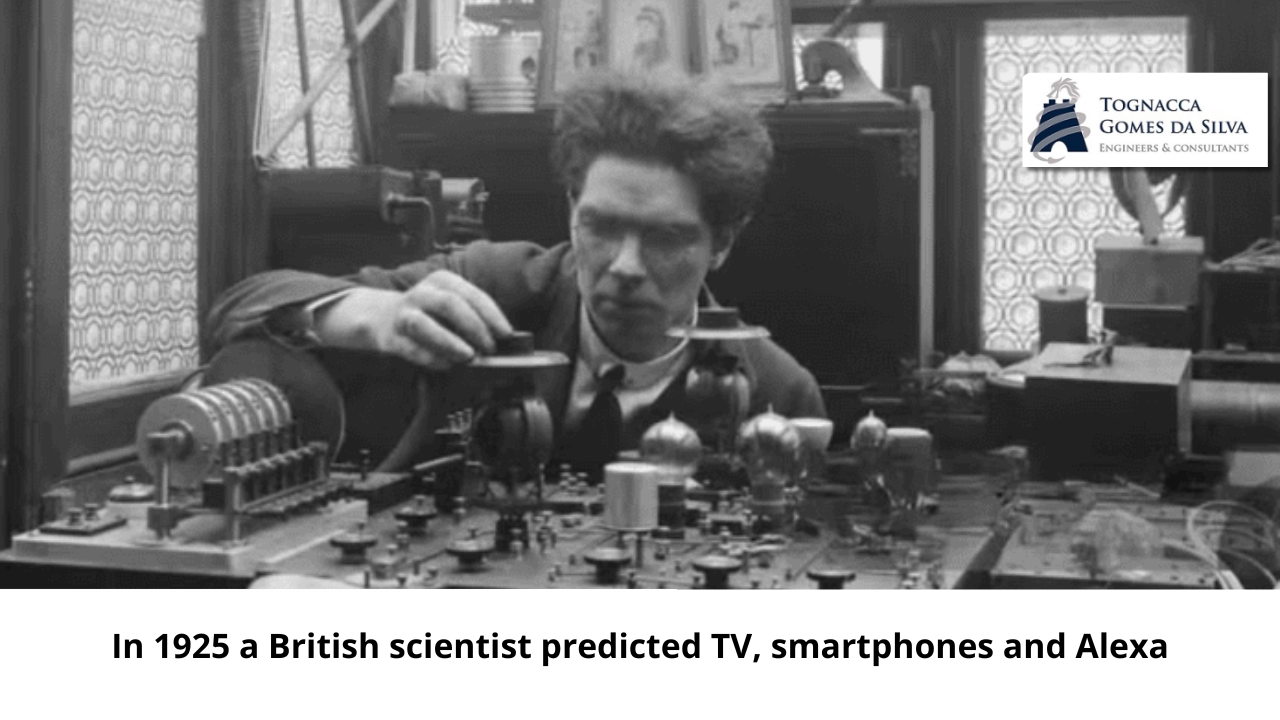



In 1925, the British engineer and scientist Archibald Montgomery Low published the book The Future, in which he imagined what life would be like a century later. What might seem like a futuristic delirium turned out to be a real success on several fronts of modern technology.
At the time when television was just a laboratory experiment, Low already predicted that the “television machine” would surpass the newspapers as the main source of news and entertainment. It hit the mark: TV established itself as the dominant medium in the 20th century and paved the way for the streaming era.
“Home Speaker” era tra le previsioni
Another certain hypothesis was what he called a “home speaker,” a device that would keep people informed inside the house. Today this description immediately recalls voice assistants, such as Alexa and Google Home, as well as notifications on smartphones.
Low also anticipated that heavy landline phones would be replaced by automatic and practical versions, a vision that directly echoes in smartphones. Even the alarm clock, which at the time depended on a “human alarm clock” knocking on the windows, was reinvented in his imagination: it spoke of sound alarm clocks and clock radios programmed to wake up at the right time, which is trivial nowadays.
The British scientist even predicted the escalators
But the predictions went beyond the screens and gadgets. The scientist believed that relying on the legs to climb the stairs was a “waste of time” and suggested moving sidewalks and escalators, technologies that decades later had become common in airports and shopping centers. He also imagined a future in which machines would do all the heavy work, anticipating automation and robotics, and foresaw the use of the force of wind and tides for energy production, a central theme of the discussions on sustainability in the 21st century.

Known as the “father of radio guidance systems,” Low designed the first motorized drone and collaborated in military research during World War I. Visionary and controversial, his ideas were met with skepticism and even irony at the time; the London Daily News called them “horrors”. A century later, however, many of them sound more like brilliant anticipations of our connected daily lives.

Now there’s the provocation: if Low managed to imagine 2025 in 1925, which of today’s emerging technologies will shape life in 2125? Could you predict?
( fontes: olhar digital)