



Tractian is valued at US$1.4 billion and becomes Latin America’s largest AI company
Author: Pedro Arbex | Source: Brazil Journal
Over the past two years, Tractian has radically transformed its business.
The startup – which uses sensors and artificial intelligence models to prevent problems in industrial machinery – moved its headquarters to the United States, now its main market, and significantly broadened its scope.
Previously, the company only did mechanical monitoring of assets, which the market nicknamed a ‘predictive band-aid’. Now, “we have truly become a physical AI company,” CEO Igor Marinelli told Brazil Journal. “We started looking at equipment in all its dimensions:”
- mechanical, which we already had;
- electrical, analysing the full pattern of power consumption and discharge;
- operational, analysing the operating context of each machine;
- computer vision, which complements the other three.
Revenue up 2.5x and unicorn status
Tractian’s revenue grew 2.5-fold, reaching annual recurring revenue (ARR) of almost US$100 million last month, while its customer base jumped to more than 2,000 factories, with profitability also improving and approaching breakeven.
Now this transformation is being rewarded: Tractian has just joined the select group of Brazilian unicorns.
The startup closed a US$130 million Series D round at a post-money valuation of US$1.4 billion – double what it was valued at in its last raise, exactly two years ago.
The valuation also makes Tractian the largest artificial intelligence company in Latin America, edging past legaltech Enter, valued at US$1.2 billion in a recent round.
The Series D was led by two existing investors, Sapphire Ventures and Catalyst, with participation from N47, General Catalyst, Bosch Ventures, 53 Stations, Monashees, Endeavor Catalyst, Norte Ventures and Y Combinator – a rare Series D investment by the American accelerator.
How the technology works
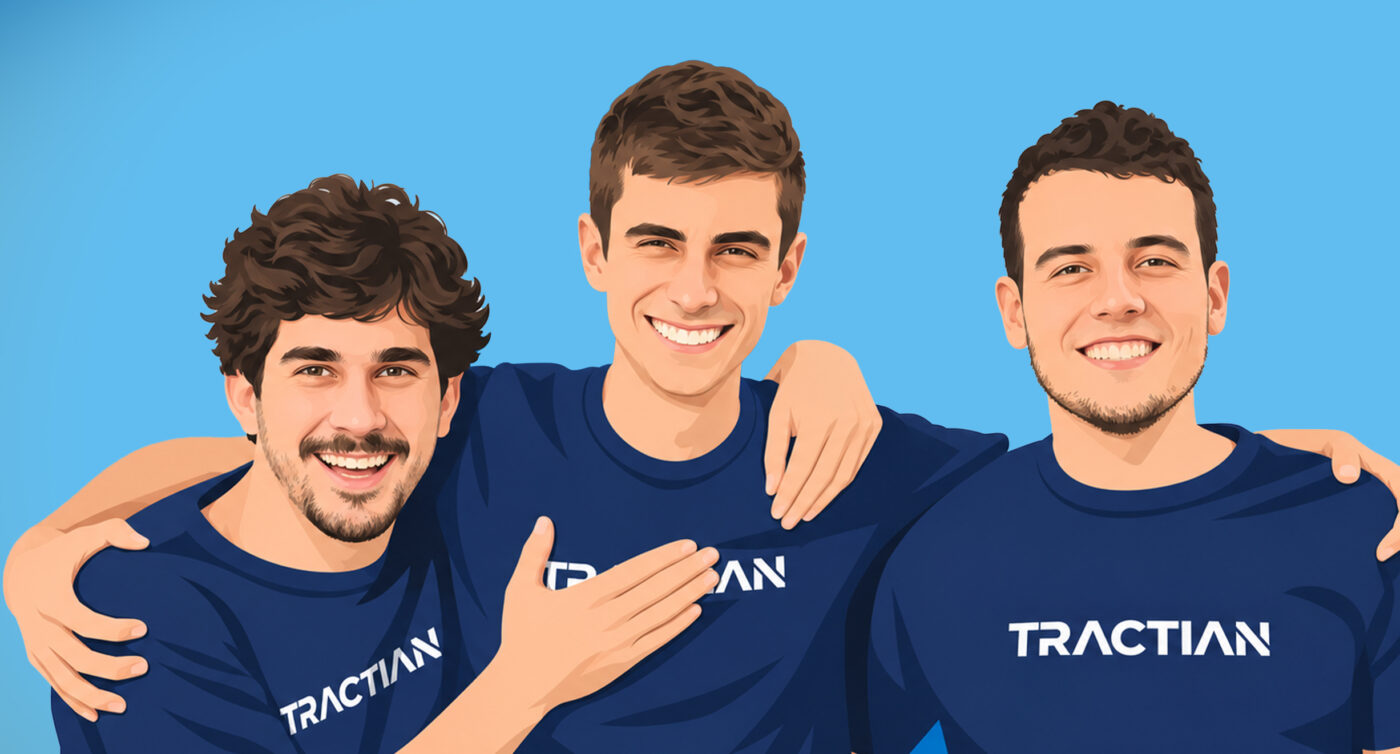
Founded in 2019 by Marinelli, Gabriel Lameirinhas and Leonardo Vieira, Tractian combines the so-called ‘Internet of Things’ with AI models.
The startup develops sensors that are loaned to industrial companies and installed on their machinery. These sensors capture data such as vibration, temperature, pressure, flow, current and voltage, which are then analysed by the company’s models to support preventive maintenance.
If a Tractian sensor detects, for example, that a machine is short of lubrication, the company’s software cross-references this with the manufacturer’s datasheet and identifies the root cause. The model then suggests the fix – replacing a component or using a specific lubricant, for instance.
Tractian’s seed was planted in the corridors of USP (University of São Paulo), where Marinelli and Lameirinhas studied computer engineering. The two met on the first day of class and, a few months later, were already sharing an apartment with the idea of starting a business together.
Where the money will go
The proceeds will be used to step up R&D, focusing on two fronts:
- developing a system that lets Tractian’s models control customers’ machines and carry out certain actions;
- developing sensors to monitor robots inside factories, a growing market.
“Today we already give recommendations, such as balancing a machine or switching off one air compressor and turning on another, but we don’t execute them,” said Igor. “We are evolving towards execution, which helps reduce customers’ costs. But that involves not only software but hardware changes as well.”
According to him, Tractian is already running tests with some customers in the US and plans to launch a product next year.
Another strategic priority will be expanding the sales and marketing team to capture a fast-growing customer segment: AI data centres. Tractian already serves three large data centre companies in the US and sees room to grow further in this segment.
Goal: US$500 million in ARR and a US IPO
The goal for the next three to five years is to reach around US$500 million in ARR and pursue an IPO in the US – an ambition the founder has had since moving the company’s headquarters to Atlanta.
Marinelli said he made that decision – even though some investors thought it premature – because from the start he believed the US would be the company’s largest market.
“And if the US was going to be our biggest market, we had to get there quickly, to have the best product there and compete with whoever our real competitors would be,” the founder said.
“You can’t compete globally while staying in Brazil. Not to mention our problems with currency, political instability and the size of our GDP. Texas alone is the size of Brazil.”
