



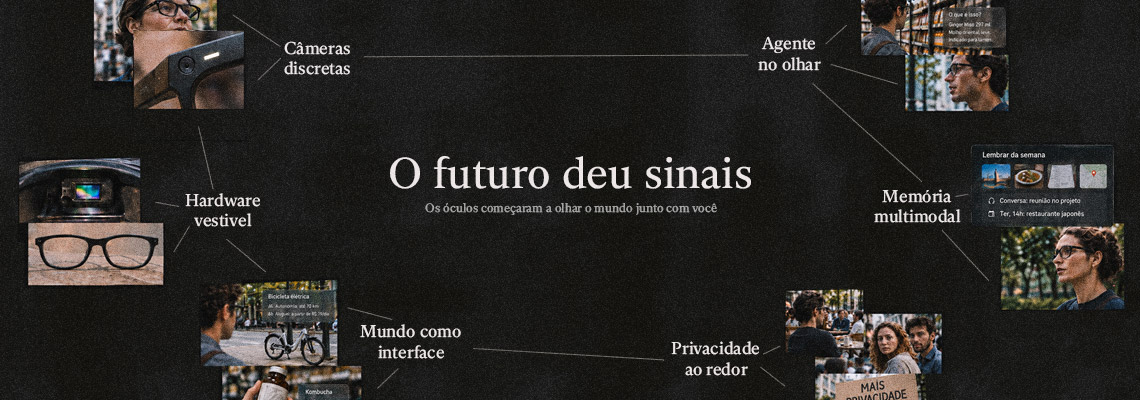
Glasses have started looking at the world along with you
Author: Hugo Rosas | Source: MIT Technology Review Brasil
For much of the history of personal computers, using a machine required telling it where our attention was. You had to type a question, tap a screen or point a camera. Glasses with artificial intelligence are beginning to change that sequence.
In September 2026, during the Meta Connect event, Meta – the technology company that grew out of Facebook and today brings together huge social networks such as Facebook, Instagram and WhatsApp – announced that it intends to bring its personal agent Muse to AI glasses. According to the company, users will be able to ask the system to act on what they are looking at, without having to describe the object or the scene. A product on a shelf or a leaflet can serve as the starting point for an action by the agent. The company also announced an expansion of its product line and said the devices will arrive in Brazil.
Muse was not yet widely available on the glasses when it was announced. But the proposal reveals a change in interface. On a phone, there is usually an explicit action when someone opens the camera and points the device. With glasses, the sensor already roughly follows the direction of the gaze. When that stream can be interpreted by a multimodal system and connected to an agent, whatever appears in front of the person starts to function as computational context. And that context includes other people.
Also in 2026, MIT Technology Review showed how smart glasses are already causing privacy conflicts in India. The report recounts the case of a trans graphic designer and educator who later discovered she had been filmed with Meta glasses during a protest in Delhi. It also describes the use of these devices by police to record demonstrators.
These are different uses, but they point to the same shift. When a camera, a microphone and artificial intelligence follow a person’s point of view, the people around them can also enter the system’s field of perception. And this transformation did not start now.
The signs that were already there
In 2021, the article “Why Facebook is using Ray-Ban to claim a right over our faces” discussed the Ray-Ban Stories, which at the time could take photos, record video, play audio and take calls. The central issue was not just the camera, but how discreet it was.
Smartphones provide relatively easy-to-recognize cues when someone points them at another person. In glasses, the camera blends into an everyday object. A small light indicated recording, but it could be hard to notice from a distance.
Five years later, that discussion took on another dimension. Instead of only wanting to know “whether someone is recording,” we have become curious about when a device is interpreting the environment with AI.
The second sign came from the hardware. In 2024, the article “These tiny pixels are ready to dominate augmented reality” analysed advances in micro-OLEDs and micro-LEDs. Smaller, denser pixels could reduce the size and weight of devices worn on the face, bringing augmented-reality systems closer to the form of ordinary glasses.
This is not exactly the same architecture as current Ray-Ban glasses, many of which do not have a display in front of the eyes. The report, however, was tracking an important barrier for wearable computing. To stay on someone’s face for hours, a computer needs to become smaller, lighter and less different from an everyday accessory.
This also has a social consequence. The less a computer looks like a computer, the smaller the visible gap may be between simply looking at something and using a machine to observe it. Another piece was still missing.
It became clearer at the end of 2024, when the article “Google’s new Project Astra could be the great trump card of generative AI” followed a Google DeepMind prototype able to take in text, speech, images and video.
During the demonstrations, Astra talked about what the camera was showing and kept part of the recent video in the session’s memory. Google also presented prototypes of the system running on glasses.
The idea anticipated an important change. Instead of receiving a single photograph and waiting for a question, artificial intelligence could follow the environment, relate images to what the person was saying and retrieve elements seen earlier.
Users would no longer need to turn everything they see into a prompt. Part of the world could reach the system directly through the sensors.
When looking also produces context
In 2026, these three trajectories are beginning to converge, and it is their combination that changes the function of the glasses. A traditional camera produces a photograph or a video. A computational perception system can extract information from the scene even when the goal is not to produce a file to be watched later.
That distinction also complicates the social signals we use to understand what a device is doing. A light can warn that a camera is recording a video. It is harder to communicate that a system is analysing objects, voices or people in order to respond to a request.
Meta itself distinguishes active captures, such as photos and videos, from artificial-intelligence features that interpret the environment. The company also announced that it intends to bring to the glasses its Private Processing system, designed to protect certain data used by artificial intelligence. These measures may address part of the technical problem, but they do not eliminate the social question.
People who buy the glasses choose to use the system and receive information about how it works. The people who pass in front of the camera do not necessarily make any of those choices. Even so, they can become part of the scene used to produce a response.
Smartphones and security cameras already created similar problems. Glasses add a particular combination of proximity, mobility and discretion. They follow the wearer through space and observe roughly what that person observes. Muse still has to deliver what Meta announced in 2026. But the direction of the change is already visible.
The future was giving signs when glasses became better at hiding a camera on the face. Another clue came when the hardware shrank and models learned to interpret what the camera sees. Now artificial intelligence is beginning to receive, as context, the very point of view of the person using the device.
