



PsiQuantum: The quantum computer made of light and the race for fault tolerance
Quantum computing is about to take a monumental leap, and the answer to its greatest challenges may not lie in superconducting circuits operating at temperatures near absolute zero, but rather in particles of light. PsiQuantum, one of the most promising and well-funded tech companies in the sector, is betting all its chips on silicon photonics to build the world’s first commercially viable, fault-tolerant quantum computer. This approach differs radically from traditional methods and promises to overcome the industry’s biggest bottleneck: scalability.
The Photonic Approach: Light Instead of Matter
Unlike corporate giants such as IBM and Google, which use matter-based superconducting qubits, PsiQuantum utilizes photons—individual particles of light—as the fundamental unit of quantum information. The great advantage of this architecture is the inherent stability of light. Photons do not feel heat and do not easily interact with the external environment, making them significantly more immune to the quantum noise that destroys calculations in other machines. Furthermore, light can be routed using conventional optical components that have long been standardized by the telecommunications industry.
Large-Scale Manufacturing with Silicon
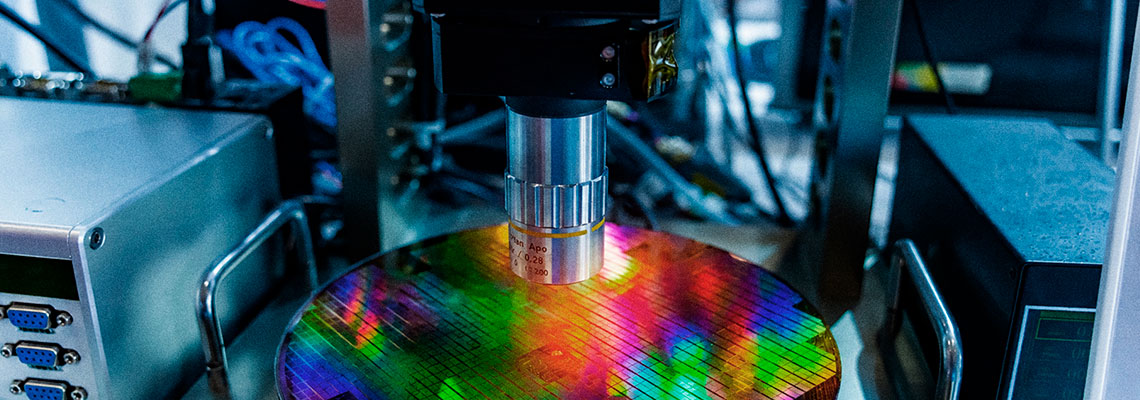
PsiQuantum’s true strategic trump card is its direct alliance with the existing semiconductor manufacturing infrastructure. By focusing on silicon photonics technology, the company can print its quantum chips in the same Tier 1 foundries that manufacture the conventional processors found in smartphones and commercial data centers.
This ability to leverage mature manufacturing processes eliminates the need to build exotic laboratories and customized assembly lines. The result is the mass production of quantum components with nanoscopic precision, an essential step in transforming the technology from a scientific experiment into a reproducible commercial product.
The One Million Qubit Milestone
PsiQuantum has been extremely vocal about a technical fact that many in the industry try to downplay: for a quantum computer to solve real and transformative problems—such as discovering new drugs, simulating new materials, or designing super-efficient batteries—it will require error correction. And error correction requires scale.
The company has outlined an aggressive engineering roadmap focused not on intermediate machines of tens or hundreds of qubits (the so-called NISQ era), but directly on the milestone of 1 million physical qubits. Only with this mathematical magnitude will it be possible to create “logical qubits,” which are blocks of information stable enough to execute complex algorithms without suffering data collapse.
Thermal and Engineering Challenges
The path to the photonic quantum computer is not without monumental obstacles. Although the photons themselves do not require extreme cooling, the superconducting photon detectors—which are highly sensitive and necessary to read the results of the calculations—still operate at strictly cryogenic temperatures.
The architecture designed by PsiQuantum requires a complex networked cooling system and a tangle of surgically precise fiber optic connections to link the multiple independent chips that will form the final supercomputer. It is a monumental challenge in systems engineering, transitioning from fundamental physics to data center infrastructure logistics.
Conclusion
If PsiQuantum is successful in its technological roadmap, the quantum computer will leave the realm of fragile experimental physics to become robust and scalable high-performance computing infrastructure. The promise of a computer made entirely of light could indeed be the definitive catalyst for the era of commercial quantum supremacy.
