



The Invisible Cost of Legacy: Why Corporate Artificial Intelligence Requires a New Infrastructure Layer
The race to integrate generative Artificial Intelligence (AI) and predictive algorithms into the corporate environment has reached a frantic pace. Enticed by the promise of large-scale automation and hyper-personalization, boards of directors demand rapid implementations. However, as they move from the proof-of-concept phase to production, organizations collide with a monumental financial and technical obstacle: legacy technological infrastructure. Attempting to overlay cutting-edge AI models onto systems built decades ago is exposing an “invisible cost” that paralyzes innovation and drains budgets.
The Bottleneck of Traditional Systems
The IT architecture of most large enterprises was designed for a different era. Static relational databases, monolithic ERP systems, and on-premise data centers were built to record transactions in a secure and structured manner, not to feed neural networks hungry for unstructured data in real time. When an AI model attempts to extract context from these antiquated architectures, the result is a fragile integration process characterized by high latency and security vulnerabilities.
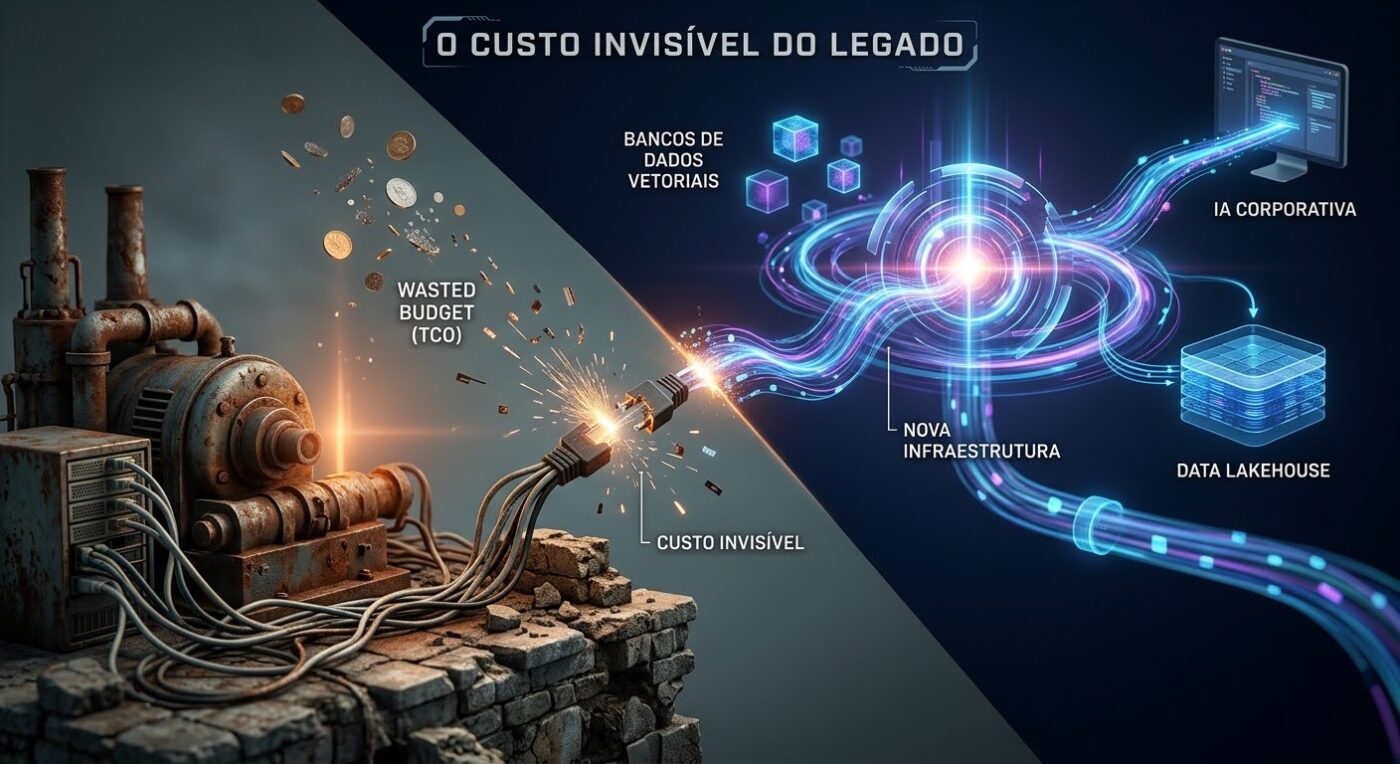
The invisible cost manifests primarily in data engineering. It is estimated that tech teams spend up to 80% of their time cleaning, restructuring, and migrating data from isolated silos into formats that AI can consume. This continuous manual effort not only delays the time-to-market for intelligence solutions but exponentially inflates the project’s total cost of ownership (TCO).
“You cannot attach a hyper-speed engine to a horse-drawn cart. Modern artificial intelligence demands modern data pipelines; attempting to avoid infrastructure modernization merely shifts technical debt into the future, with compound interest.”
The Need for a New Infrastructure Layer
For corporate AI to be scalable and financially viable, organizations must invest in building a new intermediate infrastructure layer. This goes far beyond simply migrating servers to the cloud. It is about restructuring how information flows and is processed within the company.
- Vector Databases: Unlike traditional databases, vector databases are essential for storing the mathematical representations (embeddings) used by Large Language Models (LLMs), enabling ultra-fast semantic searches.
- Data Lakehouse Architectures: Merging the flexibility of data lakes (for unstructured data such as audio and text) with the reliability of data warehouses, creating a single, governed repository ready for machine learning model training.
- APIs and Orchestration Middleware: Modern integration layers that isolate AI from legacy systems. If an old system fails or slows down, the middleware ensures the AI application is not interrupted by managing traffic and protecting sensitive data.
Security, Governance, and Return on Investment
Obsolete infrastructure also presents a severe governance risk. AI models fed by untrackable data streams can generate “hallucinations” or violate privacy regulations such as GDPR. A new infrastructure layer allows the implementation of governance policies at the data level, ensuring that information fed into the AI is anonymized and auditable.
Although modernization requires a high initial capital expenditure (CAPEX), the return on investment is justified by the elimination of the invisible cost of legacy maintenance. Companies that invest in data foundations can deploy new autonomous agents in weeks rather than semesters, ensuring their AI applications operate with the resilience and precision demanded by the modern market.
Conclusion
The true artificial intelligence revolution will occur not just in the algorithms, but in the infrastructure engineering that supports them. Treating AI as a simple application to be installed on top of architectures of the past is a strategy doomed to fail. The future belongs to organizations that have the courage to modernize their technological core, building the necessary foundation for next-generation intelligence.
